
ISDN gateways
ISDN VoIP gateways: BRI and PRI to SIP
The ISDN side of the modular platform: one housing, one web interface, from a single BRI pair to 60 PRI channels.
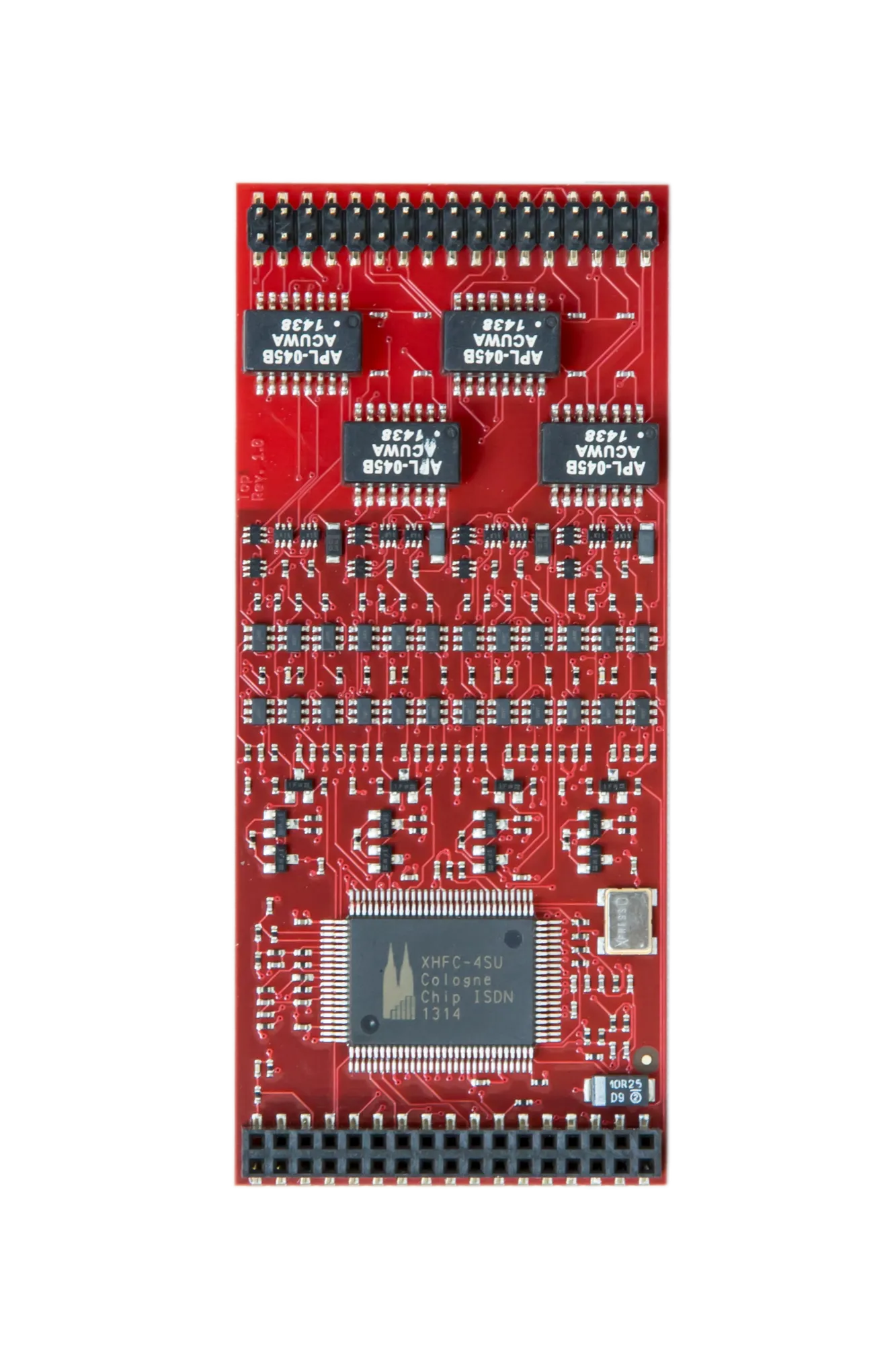
ISDN was supposed to be gone by now, and in most contracts it is. What is not gone is the equipment behind it: the PBX that still has years of depreciation left, the DECT installation whose base stations hang off an S0 bus, the alarm system that dials out over a B channel. An ISDN gateway is what lets that equipment keep working after the line behind it has become a SIP trunk.
All of these models are the same modular eSBC platform with an ISDN module fitted. That matters for two reasons. The interface can change later without changing the device — a 4 BRI module out, a PRI module in, when the site consolidates. And the SIP side is a full SBC: topology hiding, header rewriting, codec conversion and two network ports, not just a protocol converter.
Every port switches between TE and NT mode in software, pin swap and 100 ohm termination included. That is the difference between a site visit and a browser tab when a site turns out to be wired the other way round than the plan said. The BRI and PRI modules carry a high precision clock, which is what a DECT installation needs before it will stay in sync across base stations.
One licensing point, because it is often assumed the other way round: calls between the ISDN ports and SIP need no session licence. The transparent and transcoded session licences apply to SIP-to-SIP traffic only. A pure ISDN-to-SIP gateway needs none of them.
For the Americas the PRI models can be built with a T1 module instead of E1. Fax servers reach the line through beroCAPI, which keeps the CAPI application on a virtual machine rather than on a server with a card in it.
Analogue interfaces on the same platform are described under analogue gateways. The platform itself, its session licences and the full module range are on the Enterprise SBC and add-on modules pages.
Features
- Every port switchable between TE and NT mode in software, including pin swap and 100 ohm termination — no jumpers
- High precision clock on the BRI and PRI modules, which is what DECT base stations need to stay in sync
- Q.921 and Q.931 (EuroISDN DSS1) with CLIP and no screening, CLIR, COLP, UUS, MCID, CD, CNIP and AOC-D; Q.SIG with CNIP
- Calls between ISDN and SIP need no session licence; only SIP-to-SIP traffic is licensed
- Fax servers reach the line through beroCAPI without an ISDN card in the server
- T1 modules available for the Americas instead of E1
Technical specifications
| Interfaces | BRI (S0) and PRI (S2M, E1); T1 on request for the Americas |
|---|---|
| Port mode | TE or NT per port, switchable in software with pin interchange; 100 ohm termination per port |
| Clock | High precision clock on the 4 BRI, 8 BRI and all PRI modules |
| Signalling | Layer 2 Q.921, layer 3 Q.931 (EuroISDN DSS1); DSS1 with CLIP and no screening, CLIR, COLP, UUS, MCID, CD, CNIP, AOC-D; Q.SIG with CNIP |
| Voice | G.711 with echo cancellation on up to 16 channels; G.723.1 with Annex A, G.729 a/b and G.726; G.168/G.165 up to 128 ms |
| Fax | T.38 fax relay (V.27, V.29 and V.17); CAPI 2.0 through beroCAPI |
| SIP | RFC 3261 over UDP or TCP, optional TLS 1.2, SRTP; up to 128 transparent SIP-to-SIP sessions with licences |
| Housing | M 168 x 170 x 42 mm, L and XL 218 x 170 x 42 mm; 1U, wall or 19-inch mounting |
| Compliance | CE per EN 55022, EN 55024 and EN 60950 |
Models and configurations
| SKU | ISDN gateways | Concurrent sessions | PSTN channels | |
|---|---|---|---|---|
BNSBC-M-2HYB | Two BRI and two FXS | 128 / 8 | 6 | View in shop |
BNSBC-M-4BRI | Four BRI, high precision clock | 128 / 8 | 8 | View in shop |
BNSBC-M-8BRI | Eight BRI, high precision clock | 128 / 8 | 16 | |
BNSBC-L-4BRI | Four BRI, three module slots | 128 / 32 | 8 | View in shop |
BNSBC-M-1E1 | One PRI (E1), 16 channels usable | 128 / 8 | 16 | View in shop |
BNSBC-L-1E1 | One PRI (E1), full 30 channels | 128 / 32 | 30 | View in shop |
BNSBC-L-2E1 | Two PRI (E1) | 128 / 32 | 60 | View in shop |